

Starting a clothing business can involve much more than choosing clothes and selling them. You need to decide what products to sell, identify your customers, understand fabric quality, choose suppliers or manufacturers, select a suitable business structure, manage GST and finances, and build a reliable sales channel.
For entrepreneurs planning to launch an online clothing business, a website can also become an important part of the brand, allowing you to control your product presentation, customer experience and sales process.
This guide explains the major steps involved in starting a clothing business in India and the areas you should understand before investing your money.
What Is a Clothing Business?
A clothing business involves sourcing, manufacturing, branding, wholesaling or selling apparel to customers.
Depending on your business model, you may:
-
-
- Manufacture your own clothes
- Buy garments from manufacturers or wholesalers
- Create a private-label clothing brand
- Sell through marketplaces
- Build your own online store
- Supply clothing to retailers
- Export garments to international customers
-
The right model depends on your budget, target market, product category, manufacturing access and sales strategy.
How to Start a Clothing Business in India
A practical starting process can look like this:
-
- Choose your clothing niche
- Research your target customers
- Select products
- Study fabric and garment quality
- Find manufacturers or suppliers
- Calculate your costs and pricing
- Choose a business structure
- Understand GST and tax requirements
- Create your brand
- Build your website or sales channel
1. Choose Your Clothing Business Niche
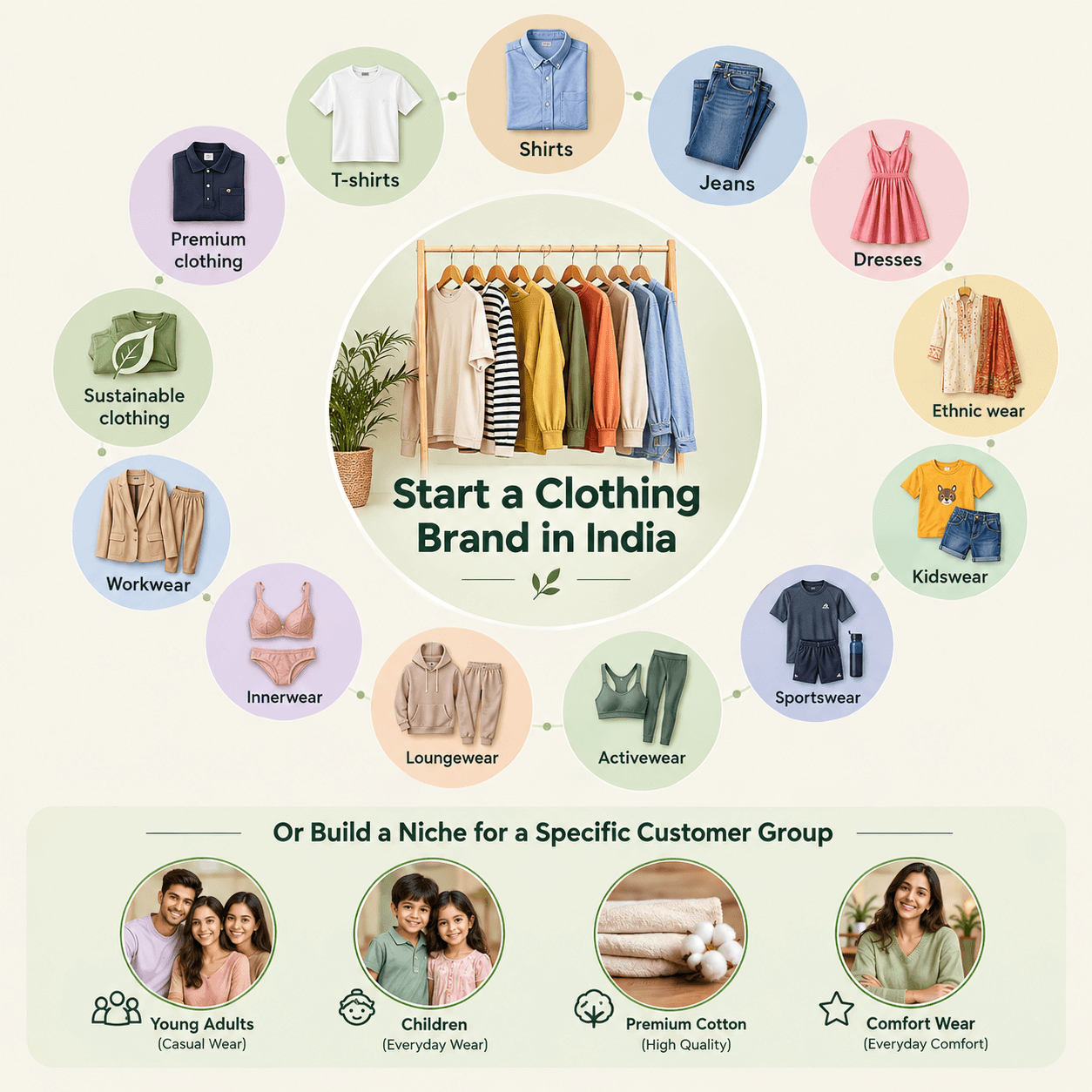
The clothing market is broad, so choosing a specific category can make your initial business strategy clearer.
Possible categories include:
-
-
- T-shirts
- Shirts
- Jeans
- Dresses
- Ethnic wear
- Kidswear
- Activewear
- Sportswear
- Loungewear
- Innerwear
- Workwear
- Sustainable clothing
- Premium clothing
- Customized clothing
-
You can also build a niche around a specific customer group rather than simply selling different types of clothes.
For example, a brand could focus on casual clothing for young adults, comfortable everyday wear, children's clothing or premium cotton products.
2. Research Your Target Customers
Before purchasing inventory, understand who you want to sell to.
Research:
-
- Age group
- Location
- Budget
- Preferred styles
- Sizes
- Fabric preferences
- Buying frequency
- Online shopping habits
- Price expectations
The goal is not to sell everything to everyone.
A clearly defined customer profile can help you make better decisions about product design, fabric, pricing, photography, packaging and marketing.
3. Decide Whether to Manufacture or Source Products
One of the biggest decisions is whether you will manufacture clothing yourself or purchase finished products.
Manufacturing
Manufacturing gives you greater control over:
-
- Fabric
- GSM
- Colors
- Designs
- Measurements
- Finishing
- Labels
- Packaging
However, it can require more planning, quality control and working capital.
Wholesale Sourcing
Buying finished garments can be simpler for a new business.
You may purchase products from wholesalers and resell them through your own store or other sales channels.
Private Label
With private label clothing, a manufacturer produces garments that are sold under your brand.
This can allow you to develop your own brand without necessarily owning a factory.
Before choosing a supplier, compare MOQ, pricing, fabric specifications, production time, customization options and quality-control processes.
4. Understand Fabric Quality and GSM
Fabric quality can directly affect how customers perceive your clothing.
One important specification is GSM, which means grams per square metre.
Generally, GSM indicates the weight or density of a fabric, but a higher GSM does not automatically mean better quality.
When evaluating fabric, consider:
-
- GSM
- Fiber composition
- Yarn quality
- Weave or knit
- Softness
- Breathability
- Shrinkage
- Colorfastness
- Durability
- Finishing
For cotton clothing, you should also understand the difference between different cotton types and fabric constructions.
A supplier should be able to provide clear specifications rather than relying only on descriptions such as "premium" or "high quality."
5. Find Reliable Clothing Manufacturers or Suppliers
Your supplier can have a major impact on your product quality and margins.
Before placing a large order, evaluate:
-
-
- Product samples
- Fabric specifications
- MOQ
- Manufacturing price
- Lead time
- Quality-control process
- Customization options
- Printing or embroidery
- Labels and packaging
- Replacement policy
- Shipping arrangements
-
6. Create a Clothing Business Plan
A simple clothing business plan should explain what you intend to sell, who you intend to sell to and how the business will make money.
Include:
1. Business Model
Decide whether you will manufacture, wholesale, private-label or resell clothing.
2. Target Market
Define your primary customer group.
3. Product Range
List your initial products, sizes, colors and variations.
4. Pricing
Calculate your total cost before deciding your selling price.
5. Sales Channels
Consider:
-
- Your own website
- Marketplaces
- Social media
- Physical stores
- Wholesale
- B2B sales
6. Marketing
Plan how customers will discover your products.
7. Financial Plan
Estimate:
-
- Initial investment
- Inventory
- Manufacturing
- Website
- Packaging
- Shipping
- Marketing
- Employee costs
- Taxes and compliance
- Working capital
7. Calculate the Cost of Starting a Clothing Business
There is no single fixed investment amount for every clothing business.
Your required capital depends on your business model and scale.
Typical cost categories include:
|
Cost Area |
What It May Include |
|
Product development |
Samples, designs and testing |
|
Inventory |
Finished garments or fabric |
|
Manufacturing |
Cutting, stitching and finishing |
|
Branding |
Logo, labels and packaging |
|
Website |
Domain, hosting, design and development |
|
Marketing |
Advertising, content and promotions |
|
Shipping |
Courier and packaging costs |
|
Business setup |
Registration and professional services |
|
Working capital |
Day-to-day operating expenses |
Do not calculate only the manufacturing price.
Your actual product cost may also include packaging, transportation, payment processing, returns, marketing and other operating expenses.
8. Choose the Right Business Structure
Depending on your circumstances, you may consider structures such as:
-
- Sole proprietorship
- Partnership
- Limited Liability Partnership
- Private Limited Company
Each structure has different legal, compliance and taxation considerations.
If you are unsure which structure is suitable, discuss your circumstances with a qualified Chartered Accountant, company secretary or legal professional.
For a growing business with multiple founders or plans for investment, the business structure can become particularly important.
9. Understand GST and Tax Requirements
GST can be an important consideration for clothing businesses, particularly when selling through different channels or operating across states.
Your GST obligations can depend on factors such as:
-
- Turnover
- Type of supply
- Location
- Sales channel
- Registration requirements
- Applicable GST rules
- If you are registered under GST, understand how invoices, returns and eligible input tax credits apply to your business.
- Do not treat GST simply as an additional cost without understanding the input-credit mechanism and your actual tax obligations.
- Because GST rules can change and depend on the circumstances of the business, verify the applicable requirements through official sources or with a qualified tax professional.
10. Build a Website for Your Clothing Business
For an online clothing business, your website can become your primary digital storefront.
A clothing website should make it easy for customers to:
- Browse products
- Select sizes
- View product images
- Understand fabric details
- Check prices
- Add products to cart
- Make payments
- Understand shipping
- Request returns or refunds
- Contact your business
Product pages should provide useful information instead of only displaying photographs.
Include details such as:
- Fabric composition
- GSM where relevant
- Available sizes
- Size chart
- Fit
- Color
- Care instructions
- Product dimensions
- Shipping information
- Return policy
Clear product information can reduce customer uncertainty before purchase.
Conclusion
Starting a clothing business in India requires decisions across products, customers, suppliers, fabric quality, finance, legal structure, GST, websites, marketing and operations.
Instead of investing heavily before understanding the market, build a clear business model, test your products, monitor your numbers and improve based on actual customer feedback.
A strong clothing business is not built only around attractive products. It also requires good financial management, reliable sourcing, consistent quality and a customer-focused selling process.