
Today, people can purchase almost anything online, from clothing and electronics to groceries and furniture. Instead of visiting physical stores, customers can browse products, compare prices, place orders, and make payments through websites. These online shopping platforms are known as ecommerce websites.
An ecommerce website allows businesses or individuals to sell products or services online. It provides customers with a convenient way to explore products, make purchases, and track their orders.
Whether you want to start an online store or expand an existing business, understanding ecommerce websites can help you choose the right website structure and features.
Let's explore the different types of ecommerce websites, their important features, and some real-world examples.
What Is an Ecommerce Website?
An ecommerce website is an online platform where businesses sell products or services directly to customers. It allows visitors to browse products, add items to a shopping cart and make secure online payments.
Key features of an ecommerce website:
-
Product listings with images, descriptions and prices.
-
Categories for organising products.
-
Shopping cart and checkout options.
-
Secure payment gateways.
-
Customer accounts and order tracking.
These features make online shopping convenient and help businesses manage sales efficiently.
Ecommerce Website vs Regular Website: What's the Difference?
Both ecommerce websites and regular websites help businesses establish an online presence, but their purposes are different.
A regular business website mainly provides information about a company, its services, and contact details. An ecommerce website allows visitors to purchase products or services directly online.
Regular Website
Company Information → Services / Portfolio → Contact / Enquiry
Ecommerce Website
Product Catalogue → Shopping Cart → Checkout & Payment → Order Management → Delivery Tracking
What Are the Different Types of Ecommerce Websites?
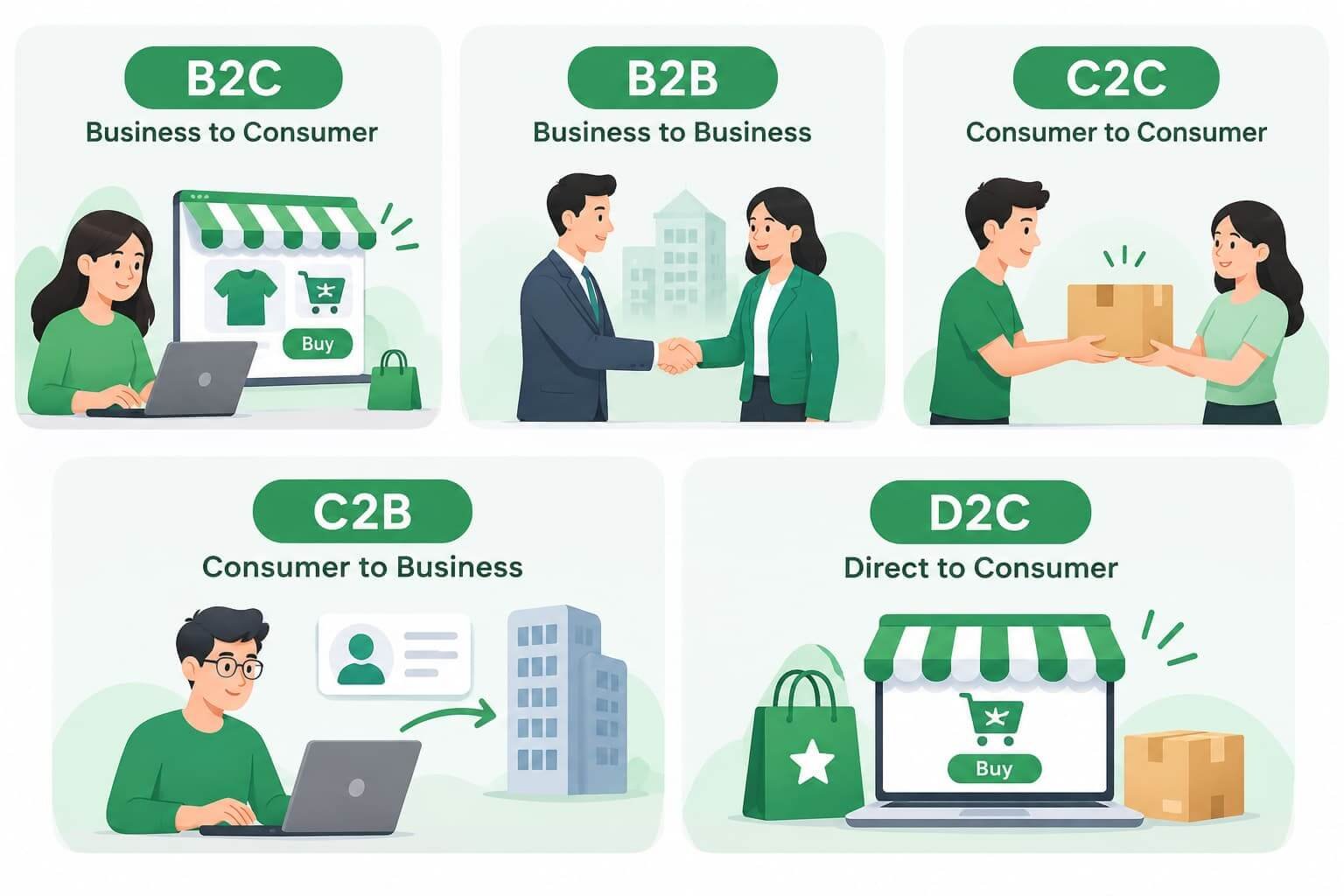
Ecommerce websites are classified based on who sells and who purchases the products or services.
Here are five common ecommerce business models.
1. Business-to-Consumer (B2C)
B2C ecommerce involves businesses selling products or services directly to individual customers.
Examples include:
- Online clothing stores.
- Electronics shopping websites.
- Grocery delivery platforms.
- Beauty and skincare stores.
Example: Amazon India and Myntra allow customers to purchase products directly through their online platforms.
2. Business-to-Business (B2B)
B2B ecommerce involves one business selling products or services to another business. It is commonly used by manufacturers, wholesalers, distributors, and suppliers.
Examples include:
- Wholesale marketplaces.
- Industrial equipment suppliers.
- Bulk raw material suppliers.
- Business software providers.
Example: IndiaMART connects businesses with suppliers across different industries.
3. Consumer-to-Consumer (C2C)
C2C ecommerce allows individuals to sell products or services directly to other individuals through online marketplaces.
Examples include:
- Second-hand clothing marketplaces.
- Used electronics platforms.
- Pre-owned furniture marketplaces.
- Online classified websites.
Example: OLX allows individuals to list and sell used products to interested buyers.
4. Consumer-to-Business (C2B)
C2B ecommerce involves individuals offering products or services to businesses.
Examples include:
- Freelance service platforms.
- Stock photography websites.
- Content creation marketplaces.
- Professional consulting platforms.
Example: A freelance graphic designer offering logo design services to a company through an online marketplace.
5. Direct-to-Consumer (D2C)
D2C ecommerce allows manufacturers or brands to sell products directly to customers without depending entirely on traditional retailers or distributors.
Examples include:
- Clothing brands selling through their own websites.
- Skincare brands selling directly to customers.
- Home furnishing brands with online stores.
- Food brands offering direct online purchases.
What Are the Important Features of an Ecommerce Website?
A successful ecommerce website needs more than attractive product images.
It should provide the features customers need to browse products, make purchasing decisions, and complete transactions.
Here are seven important features to consider.
1. User-Friendly Website Design
An ecommerce website should have a simple and organised design that helps customers find products easily.
Important design elements include:
- Clear navigation menus.
- Well-organised product categories.
- Readable fonts and suitable colours.
- Consistent page layouts.
- Clear shopping cart and checkout buttons.
2. Product Listings and Categories
Product listings help customers understand what a business sells. Each product page should include:
Each product page should include:
- Product name and images.
- Price and available discounts.
- Product descriptions.
- Size, colour, or other variations.
- Stock availability.
- Customer ratings and reviews.
3. Shopping Cart
A shopping cart allows customers to collect products before completing their purchases.
Customers should be able to add or remove products, change quantities, review prices, and proceed to checkout.
4. Secure Payment Gateway
A payment gateway allows customers to make online payments through an ecommerce website.
Depending on the payment provider, available options may include:
-
- UPI.
- Credit and debit cards.
- Net banking.
- Digital wallets.
- Cash on Delivery, where supported.
5. Mobile-Friendly Design
Many customers shop using smartphones. Therefore, an ecommerce website should work properly across mobile phones, tablets, and desktop computers.
Responsive design helps product images, navigation menus, buttons, and checkout forms adjust to different screen sizes.
6. Search and Product Filters
Search and filtering features help customers find products quickly.
Useful filters include:
-
- Product categories.
- Price ranges.
- Brands.
- Sizes and colours.
- Customer ratings.
- Product availability.
7. Order Management and Website Security
An ecommerce website should allow customers to track orders and make secure purchases.
Key features:
-
Display order history and payment status.
-
Provide shipping and delivery updates.
-
Use HTTPS and SSL/TLS security.
-
Integrate secure payment gateways.
-
Protect customer data and maintain regular backups.
Real-World Ecommerce Website Examples
-
Amazon India – Multiple product categories, filters and customer reviews.
-
Flipkart – Product categories, offers and search filters.
-
Myntra – Fashion-focused product displays and size selection.
-
Nykaa – Beauty products, ratings and reviews.
-
BigBasket – Grocery categories and convenient shopping.
What Do You Need to Create an Ecommerce Website?
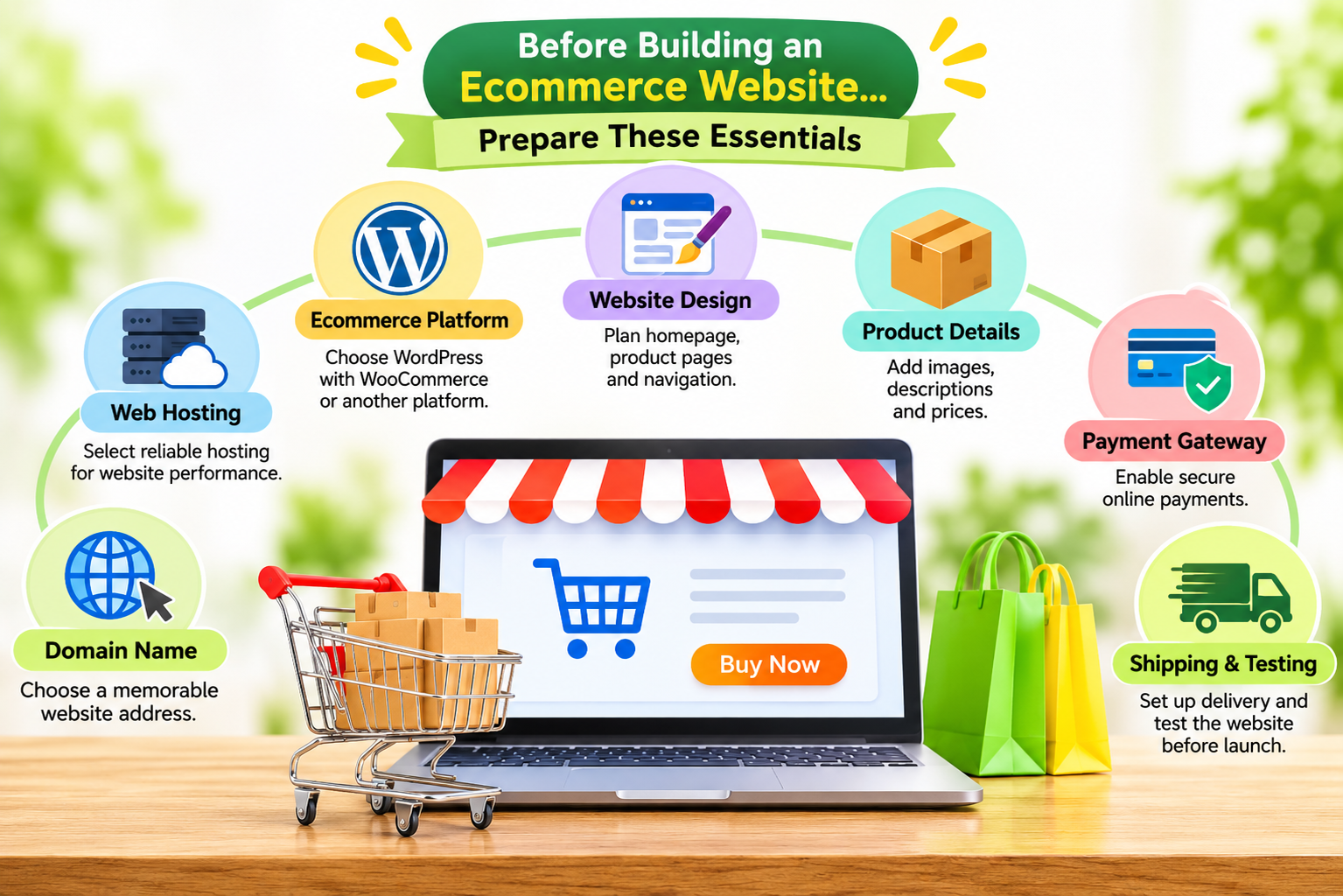
Before building an ecommerce website, prepare these essential elements:
-
Domain Name: Choose a memorable website address.
-
Web Hosting: Select reliable hosting for website performance.
-
Ecommerce Platform: Choose WordPress with WooCommerce or another platform.
-
Website Design: Plan homepage, product pages and navigation.
-
Product Details: Add images, descriptions and prices.
-
Payment Gateway: Enable secure online payments.
-
Shipping & Testing: Set up delivery and test the website before launch.
Conclusion
An ecommerce website helps businesses sell products and services online through features such as product listings, shopping carts, secure payments and order tracking.
Choosing the right ecommerce model, platform and website design helps create a smooth shopping experience.
Want to build an ecommerce website?
Budjet Websites helps businesses create professional WordPress websites tailored to their needs. Contact us to discuss your requirements and take your business online.